How Press Brake Tooling Affects Forming Quality: V-Die, Punch, and Tool Matching
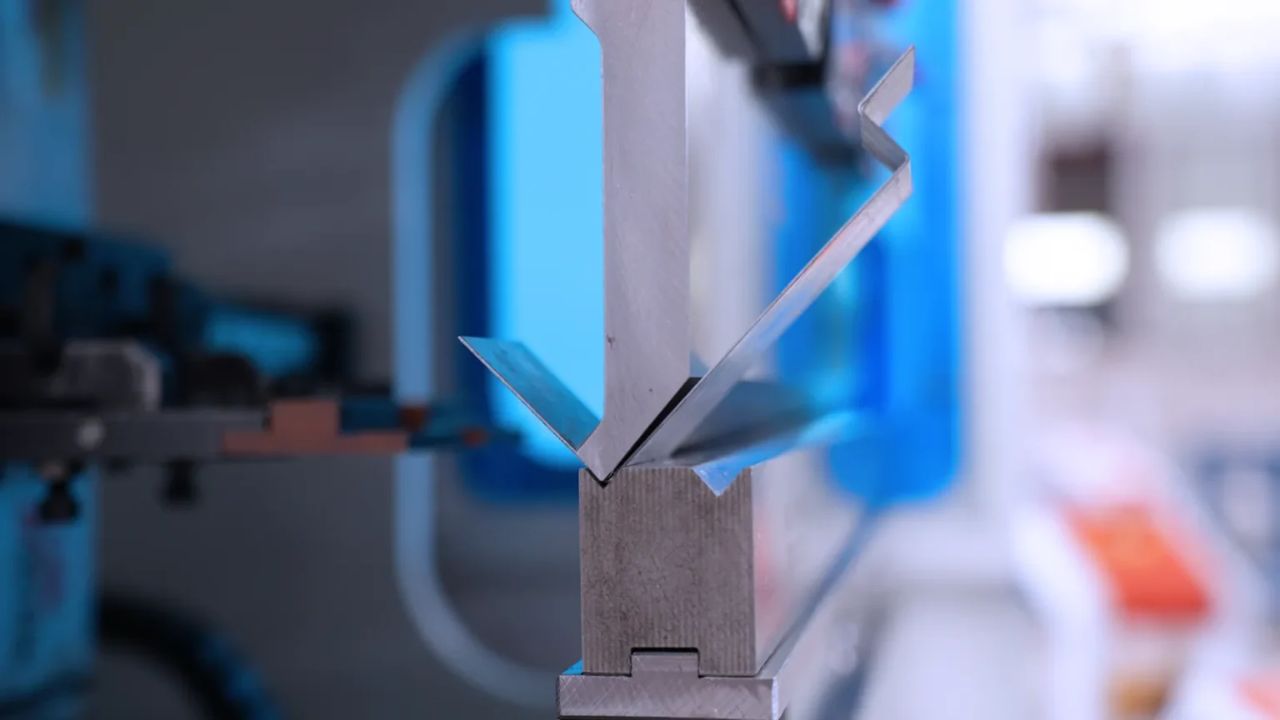
When it comes to bending quality, many workshops first look at the machine’s tonnage, control system, and operator skill level. In reality, however, improper tooling selection is often one of the most overlooked yet common causes affecting bending quality. If the wrong tools are selected, it can directly impact the required machine tonnage, the size of the inside radius, the minimum flange length, the risk of workpiece collisions, and surface quality.
Why “being able to bend” does not equal “bending consistently”
The three most common tooling misconceptions in workshops
Misconception 1: If it can bend to 90°, the tooling is correct;
If the V-die opening is too small, pressure will rise significantly, accelerating tooling wear or even causing cracks. If the punch tip radius is too small, it will also result in deeper indentations along the workpiece’s bend line.
Misconception 2: We’ve always used this combination before, so it must be fine;
Once there are changes in material strength, sheet thickness, target inside radius, minimum flange length, or surface requirements, you cannot simply continue using the previous tooling combination.
Misconception 3: Gooseneck punches are a universal solution.
Gooseneck punches do indeed have strong clearance capabilities, but their load-bearing capacity is typically lower than that of standard punches. Blindly using gooseneck punches to bend thick sheets carries the risk of deformation or even breakage.
What factors are determined by the tooling?
The tooling not only determines whether the target angle can be achieved, but also dictates the required press brake tonnage, the size of the inside radius that can be formed, whether surface indentations will occur, whether the minimum flange length can be bent successfully, whether the workpieces will interfere with the tooling, and how often tool changes will be required.
Why should you typically examine the V-die opening before the punch?
Basic relationship between the v-die opening and sheet thickness, material, inside radius, and tonnage
Taking mild steel as an example, in air bending processes, a common rule of thumb for V-die opening dimensions is 6–8 times the sheet thickness. Generally speaking:
The smaller the V-die opening, the greater the tonnage required, the greater the stress on the material, and the smaller the resulting inside radius;
the larger the V-die opening, the lower the required tonnage, the smaller the stress on the material, and the larger the resulting inside radius.
What problems arise if the V-die is selected too small or too large?
V-die too small: Pressure rises rapidly, leading to greater angle instability and potentially causing tooling wear and indentation risks;
V-die too large: The inside radius becomes larger, leading to dimensional errors; the short edge may fall directly into the lower die due to insufficient support.
The geometry of the punch determines whether the part can be produced safely and smoothly
Which parts are suitable for standard punches, gooseneck punches, and deep-throat punches, respectively
Standard punches: High load-bearing capacity; suitable for standard L-shaped parts, straight-edge parts, and other parts that do not require clearance.
Gooseneck punches: Excellent clearance capability; suitable for parts with flanges or parts that require clearance around existing bends.
Deep-throat punches: Offer even greater clearance than gooseneck punches, making them suitable for parts with very high clearance requirements, such as box-shaped parts and deep-cavity parts.
Why are minimum flange length, return stroke interference, and clearance space often overlooked?
These issues are often overlooked because, while they may appear feasible on drawings, the bending process may not proceed smoothly in actual production. Minimum flange length, return stroke interference, and clearance are often affected by the size of the V-die and the punch geometry. Therefore, before testing, we must first clarify:
First, check whether the minimum flange length meets the requirements of the current V-die;
Second, check whether existing bends are likely to interfere with the punch, die, or clamping system;
Finally, check whether the retraction path and flipping space are sufficient after multiple bends.
Why is it important to ensure compatibility of the entire tooling set for parts with multiple bends?
The value of fixed-height tooling systems, modular tooling, and multi-station layouts
For parts requiring multiple bends, the challenge lies not only in the large number of operations but also in the fact that incompatible tooling can increase costs associated with tool changes, positioning verification, first-piece verification, and process switching. Therefore, to improve efficiency, many workshops consider a comprehensive tooling system that integrates fixed-height tooling systems, modular tooling, and multi-station layouts.
Through proper tooling matching, punches with different profiles and dies with different V-die openings can be flexibly combined within the same tooling system, accommodating a wide range of internal radii and forming requirements while significantly reducing tool changes and trial bends. For further details on common tooling types, structures, and typical diagrams, refer to a more systematic press brake tooling guide.
Reducing tool changes does not equate to optimal process
Some workshops, finding tool changes cumbersome, use a single set of tooling to bend parts of different types and thicknesses. While this appears to reduce the number of tool changes, it cannot guarantee that angle stability, inside radius consistency, short-edge support, and surface quality meet requirements.
The correct approach is to first identify common methods based on workpiece families, then use specialized tooling or make localized adjustments for specific forming requirements, ensuring both efficiency and high stability.
When to consider dedicated tooling or non-marking/low-mark solutions
Why tooling for surface-sensitive parts cannot be selected using the same logic as for ordinary carbon steel parts
For surface-sensitive workpieces such as brushed stainless steel, mirror-finished panels, film-coated sheets, and aluminum sheets, we must not focus solely on whether the angles can be bent; we must also consider the risk of scratches and indentations caused by the edges of the V-die opening, surface friction, and material pickup. Common approaches include: using non-marking lower dies, placing protective film on the lower die, inserting soft inserts into the V-die edges, or selecting specialized dies with larger working radii at the V-die shoulders and better sliding characteristics, along with appropriate surface-treatment options.
Why do hemming, flattening, radius bends, and special flanging processes rely more on specialized solutions?
Not all parts can be handled effectively with standard air-bending tooling. Special operations such as partial hemming, flattening, radius bends, and special flanging are not always suitable for continued use with standard air-bending tooling. For example, flattening requires a dedicated tooling combination to close the edge while increasing edge strength; for large-radius bends that go beyond the normal forming range of standard air-bending tooling, specialized radius tooling is usually more stable.
A tooling evaluation checklist for shared use by purchasing, engineering, and the shop floor
Before finalizing a tooling solution, the following points must be clarified:
Material type: Is it stainless steel, aluminum sheet, or mild steel? Are there any surface quality requirements?
Sheet thickness: Determines the initial assessment of the V-die opening.
Target inside radius: Influenced by the V-die dimensions, determine whether the current V-die opening can produce the target inside radius specified in the drawing.
Surface requirements: What is the acceptable level of indentation on the surface? Are non-marking dies required?
Minimum flange length: Determine whether the short edge will fall into the V-die opening of the lower die.
Interference check: Determine whether existing bends will interfere with the tooling or clamping system when bending flanged parts, deep box parts, or reverse-flanged parts.
Production volume: Whether the primary production scenario involves a single product type or multiple product types, as this affects tool change frequency and the need for dedicated tooling.
Tooling Match Checklist for Better Forming Quality
Press brake tooling quality is not only about using a sharp punch or a clean V-die. The punch profile, V-opening, material thickness, bend radius, and tonnage must match the forming method. If one of these factors is wrong, the result can be angle variation, cracking, excessive marking, or poor repeatability.
A simple tooling match checklist should include:
- Match the V-die opening to material thickness and required inside radius.
- Confirm that the punch tip radius is suitable for the bend radius and material type.
- Check whether the tooling length supports the full bend without creating uneven pressure.
- Use protective film, urethane pads, or polished tooling when forming visible stainless steel or aluminum surfaces.
- Inspect worn tooling regularly because small damage can repeat across every part in the batch.
This type of review is especially important for jobs that change material thickness often. A die that works for mild steel may create defects when used on harder stainless steel or soft aluminum.
How Tool Wear Shows Up in Finished Parts
Tool wear usually appears gradually. Operators may first notice that angle correction values become larger, parts need more rework, or bend marks become more visible. If the shop does not track these changes, the problem may be mistaken for material variation or operator error.
A practical approach is to record which tooling was used for each production job and compare inspection results over time. When a specific tool set repeatedly requires correction, it should be inspected, cleaned, repaired, or replaced.
FAQ
Can better tooling reduce rework?
Yes. Correctly matched tooling reduces trial bends, surface damage, and angle variation. It also makes saved programs more reliable because the forming conditions remain consistent.
Is V-die selection more important than punch selection?
Both matter. The V-die strongly affects bend radius and tonnage, while the punch affects clearance, profile, and local pressure. Good forming quality depends on the pair working together.